
What Does a Commercial Gas Service Include?
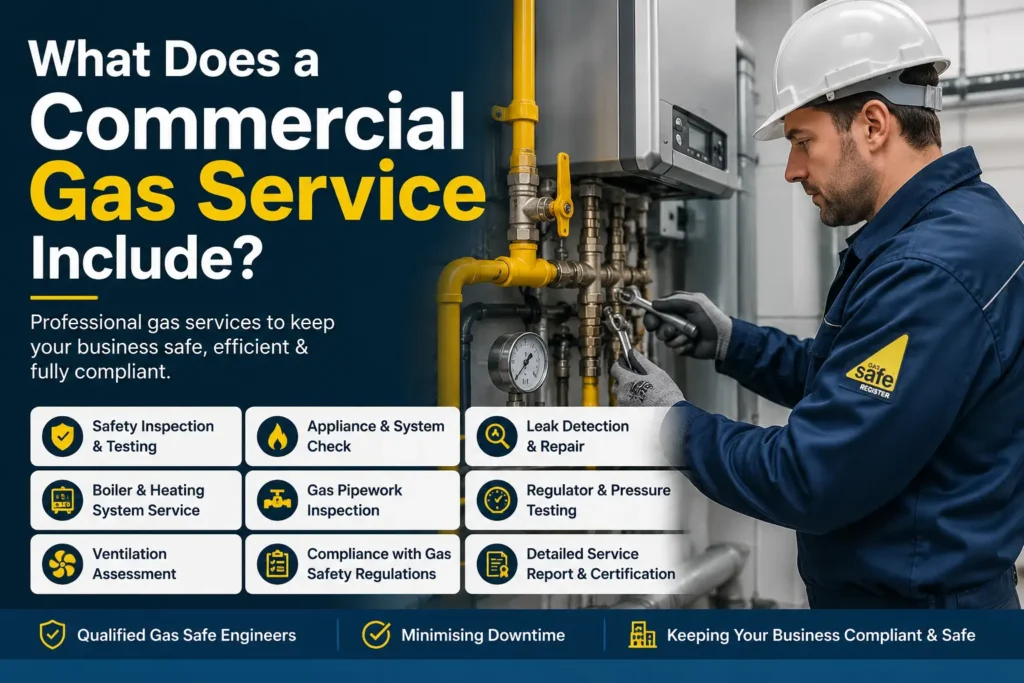
A commercial gas service is much more than switching a boiler or appliance on and checking that it works.
For a business, proper gas servicing involves looking at the appliance, gas supply, pipework, ventilation, flue, safety controls and overall operating condition of the installation. The exact scope depends on the equipment, how it is used, the manufacturer’s instructions and the requirements of the site.
This matters because commercial gas equipment often operates for long hours and can be connected to other building systems. A problem that looks minor during normal operation can become a costly breakdown — or, more seriously, create a gas safety or carbon monoxide risk.
HSE advises employers to ensure gas appliances, pipework and flues are regularly maintained and that gas work is carried out by an appropriately competent person. In many workplaces, this means using a Gas Safe registered engineer with the relevant qualification for the work involved.
So, what does a commercial gas service actually include? Let’s break it down.
What Is a Commercial Gas Service?
A commercial gas service is a planned inspection and maintenance process for gas-fired equipment and the associated installation within a commercial premises.
Depending on the site, this could involve:
- Commercial boilers
- Gas-fired heating equipment
- Water heaters
- Commercial catering appliances
- Gas-fired heaters
- Burners
- Plant-room equipment
- Associated gas pipework and controls
The engineer’s job isn’t simply to find out whether the appliance is currently working. A good service should help determine whether the system is operating safely, whether components are showing signs of deterioration, and whether anything needs attention before it develops into a larger problem.
For employers, this forms part of the wider responsibility to keep workplace gas installations safe. HSE highlights risks associated with poorly installed or maintained gas appliances, including gas leaks, fire, explosion and carbon monoxide poisoning.
What Is Included in a Commercial Gas Service?
The exact checklist varies from one installation to another, but a professional commercial gas service will generally cover several key areas.
1. Appliance Inspection and Condition Assessment
The service normally begins with an inspection of the gas appliance itself.
The engineer will look for signs of damage, deterioration, corrosion, overheating or other conditions that could affect safe operation. Depending on the equipment, this can include checking:
- Burners
- Ignition components
- Flame-failure devices
- Thermostats
- Sensors
- Safety controls
- Electrical connections associated with the appliance
- Seals and serviceable components
- General physical condition
Commercial equipment can be considerably more complex than a domestic boiler, particularly where multiple appliances operate together in a plant room or commercial kitchen. The engineer should also take account of the manufacturer’s servicing instructions rather than applying exactly the same procedure to every appliance.
2. Gas Supply and Pipework Checks
A commercial gas installation may have extensive pipework supplying one or several appliances.
Accessible pipework can be examined for visible deterioration, corrosion, damage, poor support or other issues that could compromise the installation. Where appropriate, testing may also be carried out to establish whether the gas installation is sound.
This is important because the appliance itself can be perfectly operational while a problem exists elsewhere in the gas installation. HSE advises employers to ensure gas pipework, appliances and flues are regularly maintained. For larger sites, the condition of the gas distribution system should therefore be considered as part of the overall maintenance strategy.
3. Combustion, Flue and Ventilation Checks
This is one of the most important parts of commercial gas servicing.
Gas appliances require an appropriate supply of combustion air, while combustion products need to be safely removed through the relevant flue arrangement. During servicing, the engineer may therefore assess the relationship between:
Gas supply → combustion → ventilation → flue → safety controls
Depending on the installation, checks can include:
- Combustion performance
- Flue condition
- Ventilation arrangements
- Air supply
- Signs of incomplete combustion
- Safe discharge of combustion products
- Appliance/flue configuration
- Relevant ventilation interlocks
HSE specifically highlights adequate ventilation and unobstructed flues for gas appliances. For commercial and industrial plant, it also advises consideration of ventilation interlocks and measures to prevent dangerous levels of carbon monoxide. This is why a commercial gas service should never be reduced to a simple boiler performance check.
4. Safety Controls and System Operation
Commercial gas appliances can contain multiple safety controls, and larger installations may have additional control systems connecting appliances with ventilation or other building services.
The engineer may test relevant safety functions and operating controls to establish whether the equipment responds correctly under normal operating conditions. Depending on the installation, this may involve checking:
- Flame-failure protection
- Gas pressures
- Temperature controls
- Safety thermostats
- Ignition systems
- Emergency shut-off arrangements
- Interlocks
- Relevant control sequences
The precise tests depend on the equipment and the engineer’s scope of work. For a large plant room, this wider systems approach is particularly important because an appliance may rely on other equipment or controls to operate safely.
5. Cleaning and Preventative Maintenance
Servicing can also include cleaning or maintenance of components where this is appropriate for the appliance.
Depending on the manufacturer’s requirements and equipment condition, this might involve cleaning burners, heat-transfer surfaces, filters or other serviceable components. The objective isn’t simply to make the equipment look clean — proper preventative maintenance can help the appliance operate as intended, identify deteriorating components and reduce the likelihood of avoidable faults. Manufacturers’ servicing instructions should always be taken into account when determining what maintenance is appropriate.
6. Defect Identification and Remedial Recommendations
A good commercial gas service should tell you more than whether your appliance is “working.”
The engineer should identify relevant defects or concerns and explain what needs to happen next. Potential findings could include:
- Gas leaks or suspected leaks
- Deteriorated pipework
- Combustion problems
- Flue defects
- Ventilation issues
- Faulty safety controls
- Damaged components
- Equipment requiring repair
- Equipment approaching the end of its useful service life
The recommended action depends on the severity and nature of the issue. In some cases, a relatively small repair may resolve the problem. In others, continued operation may not be appropriate until remedial work has been completed. If an appliance is known or suspected to be unsafe, it should not simply be left running because it is still producing heat — HSE advises that unsafe gas appliances should not be used and that appropriate competent personnel should deal with gas safety issues.
A Real-World Example: Why the Full Inspection Matters
Imagine a commercial property where the heating system appears to be working normally. The boiler starts, the building gets warm, and there are no obvious signs of a problem.
During a scheduled service, however, the engineer identifies an issue affecting the flue or combustion arrangement. From the business owner’s perspective, nothing appeared to be wrong, because the heating was still operating. From an engineer’s perspective, that’s exactly why planned servicing matters.
The purpose isn’t simply to repair equipment after it fails — it’s to identify conditions that may affect safe operation, reliability or future performance while there’s still an opportunity to deal with them in a controlled way.
This isn’t a hypothetical risk. HSE has investigated cases where a poorly maintained boiler contributed to dangerous carbon monoxide levels in a school building despite the heating appearing to work normally at the time — a reminder that maintenance systems need to be genuinely effective, not just exist on paper.
Does a Commercial Gas Service Include a Gas Safety Certificate?
Not necessarily. This distinction is important.
A service, a gas safety check and other forms of inspection or certification are not automatically the same thing. The documentation and checks required depend on the type of premises, equipment, occupancy and legal responsibilities involved.
For example, specific landlord duties apply to relevant rented residential accommodation under the Gas Safety (Installation and Use) Regulations. Those requirements should not automatically be applied to every commercial property. If you manage a commercial premises and are unsure which records, inspections or certificates apply to your installation, discuss the requirements with a suitably qualified gas professional.
How Often Should Commercial Gas Equipment Be Serviced?
There isn’t one universal interval that applies to every commercial gas appliance. The appropriate maintenance frequency can depend on:
- Manufacturer recommendations
- Type of appliance
- Hours of operation
- Frequency of use
- Site conditions
- Age and condition of equipment
- Previous faults
- Risk assessment
- Industry requirements
For commercial catering equipment, HSE explains that inspection periods can vary depending on the equipment and how it’s used. It recommends following the manufacturer’s guidance and states that, as a general rule, annual inspections are a reasonable minimum frequency.
For other commercial installations, the maintenance programme should be developed around the actual equipment and site conditions — not chosen purely because “that’s what we’ve always done.”
Who Should Carry Out Commercial Gas Servicing?
Gas work should be carried out by a person with the appropriate competence for the specific work involved.
For many workplaces — including shops, restaurants, schools and hospitals — HSE states that work on gas fittings must be carried out by a Gas Safe registered engineer who is qualified to undertake that type of work.
When selecting a contractor, don’t just ask “are you Gas Safe registered?” Also ask whether their registration and qualifications cover the specific commercial gas work and equipment at your premises. This matters most where the installation includes commercial catering appliances, larger boilers, burners or complex plant-room systems.
What Should a Business Receive After a Commercial Gas Service?
The exact documentation depends on the service provided, but businesses should expect clear information about the work carried out and any issues identified. Useful service documentation can include:
- Equipment inspected
- Work undertaken
- Test results where applicable
- Defects identified
- Recommended remedial work
- Parts replaced
- Further maintenance recommendations
- Relevant service or inspection records
Good records also help facilities managers understand the history of an installation, creating a useful maintenance record rather than leaving every future engineer to start from scratch.
Commercial Gas Service vs Commercial Gas Repair
A commercial gas service is generally planned preventative work. A commercial gas repair is usually reactive work carried out after a fault or failure occurs.
Commercial gas service: A facilities manager schedules maintenance before winter to assess a commercial heating system and identify developing faults.
Commercial gas repair: The boiler fails during a cold spell and an engineer is called to diagnose and repair the problem.
Neither replaces the other. A good maintenance strategy combines planned servicing with an appropriate response process for unexpected faults.
What Types of Businesses Need Commercial Gas Servicing?
Commercial gas maintenance can be relevant to many types of premises, including:
- Offices
- Schools
- Restaurants
- Hotels
- Retail units
- Warehouses
- Healthcare facilities
- Industrial premises
- Public-sector buildings
- Commercial kitchens
- Properties with dedicated plant rooms
The equipment and maintenance requirements vary significantly between these environments. A restaurant kitchen, for example, may have multiple gas-fired appliances operating intensively for long periods, while a commercial office may rely primarily on boilers and hot-water equipment. The service should be tailored to the installation rather than treated as a generic checklist.
How to Choose a Commercial Gas Service Provider
When comparing commercial gas contractors, look beyond the headline price. Consider whether the contractor can provide:
Relevant gas competence — check that the engineer has the appropriate Gas Safe registration and competencies for the work involved.
Commercial experience — commercial installations can be more complex than domestic systems, so experience with your type of equipment matters.
Clear reporting — you should understand what was inspected, what was found, and whether further work is recommended.
Preventative maintenance — a contractor should be able to help you move from reactive repairs towards a planned maintenance strategy where appropriate.
Wider plant-room understanding — for larger sites, gas appliances may interact with heating controls, ventilation, BMS and other plant-room equipment. A contractor with wider mechanical-services experience can be valuable when these systems overlap.
Why Regular Commercial Gas Servicing Matters
The biggest benefit of planned servicing isn’t simply keeping a boiler running — it’s maintaining a safer and more predictable commercial operation. Regular maintenance can help businesses:
- Identify developing faults earlier
- Reduce avoidable breakdowns
- Maintain reliable heating and hot water
- Identify gas safety concerns
- Monitor equipment condition
- Plan remedial work
- Reduce unexpected disruption
- Build a clearer maintenance history
It can’t guarantee that a breakdown will never happen, but it can reduce the risk of preventable problems being left unnoticed. A heating failure in an office is inconvenient. A failure affecting a restaurant kitchen, healthcare facility, school or production environment can have much wider operational consequences — and that distinction is exactly why the maintenance strategy should match the risk.
Frequently Asked Questions
What is included in a commercial gas service? A commercial gas service can include inspection of gas appliances and pipework, combustion and flue checks, ventilation assessment, safety-control testing, appropriate cleaning and preventative maintenance, plus identification of defects and recommended remedial work. The exact scope depends on the installation and manufacturer’s requirements.
How long does a commercial gas service take? There’s no fixed time for every commercial installation. A single appliance may require considerably less time than a plant room containing multiple boilers, controls and associated equipment. Size, complexity, access and equipment condition all affect the duration.
Does commercial gas servicing include boiler servicing? It can. Commercial gas servicing may include commercial boilers as part of the wider gas installation, provided the engineer has the appropriate competence for the equipment.
Is a commercial gas service the same as a gas safety check? No. They can involve overlapping safety-related checks, but they’re not automatically the same service or document. The legal and documentation requirements depend on the premises, equipment and circumstances.
How often should commercial gas appliances be serviced? The correct interval depends on the equipment, manufacturer’s recommendations, usage and site risk. For catering equipment, HSE states that inspection intervals can vary and that annual inspection is a reasonable general minimum where appropriate.
Does every commercial gas engineer work on every type of appliance? No. Engineers need appropriate competence for the particular type of gas work and equipment. Businesses should check the engineer’s Gas Safe registration and relevant qualifications before work begins.
What happens if an engineer finds an unsafe gas appliance? The engineer should explain the safety issue and the action required. Depending on the circumstances, the appliance may need to be repaired, isolated or taken out of service until the defect has been addressed.
Can commercial gas servicing reduce breakdowns? Planned maintenance can help identify developing faults and equipment deterioration before they lead to unexpected failures. It can’t eliminate all breakdowns, but it’s an important part of a preventative maintenance strategy.
Final Takeaway
A commercial gas service should be much more than a quick check that an appliance is still operating.
A properly planned service considers the wider installation — from the appliance and gas supply through to combustion, ventilation, flues and safety controls. It also gives businesses an opportunity to identify defects, plan repairs and maintain a clearer record of equipment condition.
Most importantly, commercial gas work should be entrusted to an appropriately competent professional. HSE advises employers to use a Gas Safe registered engineer or competent person as applicable, and to ensure gas pipework, appliances and flues are regularly maintained.
If your business needs professional inspection, maintenance or support for commercial gas equipment, explore Ultimate Engineers’ commercial gas services to see how the team can support your gas systems and wider plant-room requirements.
Further UK Gas Safety Guidance
Disclaimer: All prices, costs, estimated timeframes, and service details mentioned on this page are provided for general guidance and may vary depending on location, project requirements, availability, market conditions, inflation, and other external factors. Final pricing, costs, and timelines will be confirmed at the time of quotation or service.

Talal Ehsan
Talal is a Site Manager and Project Handler at Ultimate Engineers, overseeing projects and ensuring professional delivery, quality, and compliance across engineering services.