
Top 7 Signs Your Home Has Electrical Wiring Issues (And What to Do)
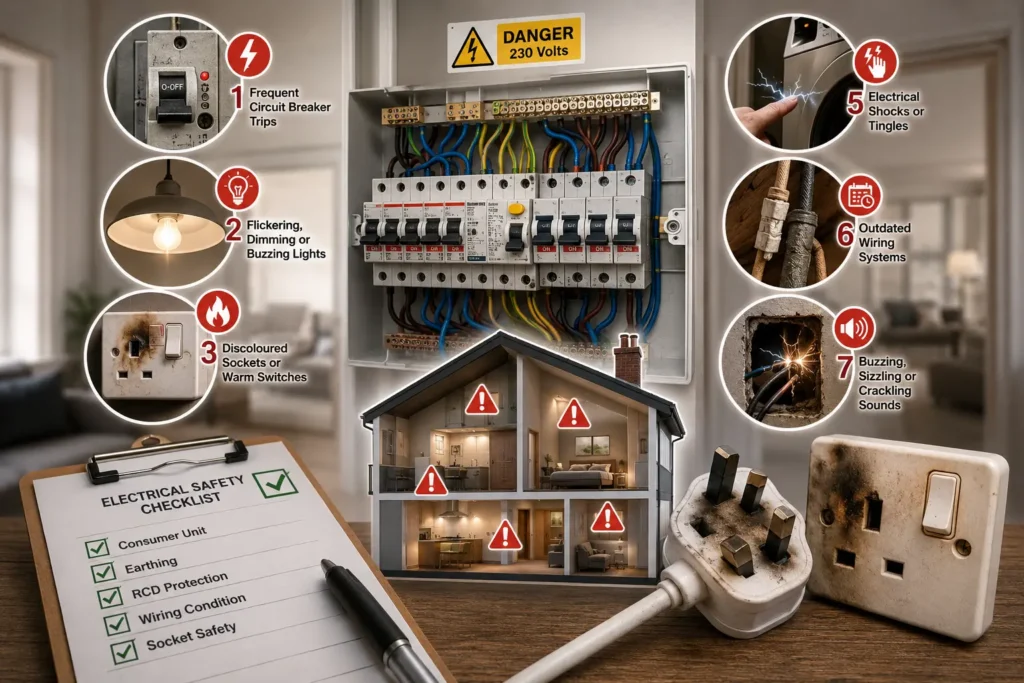
Ignoring flickering lights or a warm switch plate might seem harmless, but hidden wiring faults cause thousands of avoidable UK house fires every year.
The primary signs of faulty electrical wiring in a home include frequent circuit breaker trips, flickering or dimming lights, burnt or discoloured sockets, buzzing noises behind walls, burning plastic smells, unearthed round-pin sockets, and persistent electrical shocks.
If you notice any of these warning signs, your consumer unit or internal cabling is struggling under load or deteriorating — requiring an immediate inspection by an NICEIC-certified engineer.
1. Frequent Circuit Breaker Trips or Blown Fuses
Your consumer unit (fuse box) is designed to cut power when a circuit draws more current than it can safely handle. While an occasional trip from running a kettle and a tumble dryer on the same line happens, daily or weekly trips point to a deeper structural issue.
Likely cause:
- An overloaded circuit drawing excess wattage
- Degraded cable insulation causing a short circuit
- An outdated consumer unit lacking modern RCD (Residual Current Device) protection
What to do:
- Unplug appliances on that circuit one at a time to isolate a faulty device.
- If the breaker still trips with nothing plugged in, stop testing and call a certified electrician immediately.
2. Flickering, Dimming, or Buzzing Lights
Lights that flicker when you turn on a heavy-power appliance indicate voltage fluctuations across your home’s circuits.
- Loose connections — wires expand and contract as they heat up and cool down, causing terminal screws to loosen over time inside light fittings or switch boxes.
- Outdated wiring — older homes with original twin-and-earth wiring often lack the capacity for modern domestic electrical loads.
What to do: If replacing the bulb doesn’t fix the issue, the terminal connections behind the fixture need testing for high resistance by a qualified professional.
3. Discoloured Sockets, Warm Switch Plates, or Scorch Marks
Sockets and light switches should always remain cool to the touch and retain their clean plastic or metallic finish. Discolouration is a critical safety hazard.
| Warning Sign | Primary Technical Cause | Immediate Risk Level |
|---|---|---|
| Yellowing or brown plastic around sockets | Thermal buildup from loose internal conductors | High (Fire Hazard) |
| Warm switches or sockets | Overloaded circuit or degraded wiring connection | High (Insulation Melting) |
| Visible sparking when plugging in | Arcing due to worn contact springs inside the socket | Critical (Immediate Action Required) |
4. Persistent Burning Smells or Fishy Odours
A fishy, chemical, or burning plastic smell coming from a socket or switch is a classic sign of electrical arcing. As electricity jumps across small gaps in damaged wires, it heats the surrounding plastic casing, releasing distinct toxic fumes before visible smoke appears.
What to do: Turn off the main supply at your consumer unit immediately — do not flip individual switches, as operating local toggles can trigger severe arcing at the fault point. Contact a qualified specialist to trace the circuit — you can review official GOV.UK guidance on Electrical Safety Standards in the Private Rented Sector Regulations 2020.
5. Subtle Electrical Shocks or Tingles
Feeling a mild tingle or shock when touching a metallic appliance, toaster casing, or metal light switch is a clear sign of earthing failure.
In standard UK installations compliant with BS 7671 (IET Wiring Regulations), earthing safely directs fault currents into the ground. If your earth wire is disconnected, damaged, or missing entirely, your body becomes the path of least resistance.
6. Outdated Wiring Systems (Rubber, Fabric, or Lead Cables)
If your UK home was built before 1970 and hasn’t undergone a full house rewire, your electrical safety may be severely compromised by obsolete cable types.
| Cable Type | Operational Era | Primary Risk Factor |
|---|---|---|
| VIR (Vulcanised Indian Rubber) | Pre-1960s | Dries out, cracks, and flakes off, leaving live copper exposed |
| Lead-sheathed cabling | Pre-1950s | Lacks modern integral earthing conductors |
| Rewireable fuse panels | Pre-1980s | Lacks fast-acting MCBs and RCD shock protection |
If your property still features a wooden-backed fuse box with rewireable fuse wire, an upgrade to a modern consumer unit with RCBOs is long overdue.
7. Buzzing, Sizzling, or Crackling Sounds Behind Walls
Electricity should operate silently. If you hear a faint buzzing, sizzling, or crackling noise coming from inside your walls, sockets, or switch boxes, you are hearing electrical arcing.
Arcing occurs when an electric current jumps between loose or broken conductors. This process generates extreme temperatures exceeding 1,000°C, which can ignite surrounding timber studding, plasterboard paper, or thermal insulation within minutes.
What to do: Switch off the affected circuit at your consumer unit immediately and avoid using the area until it has been professionally tested.
Quick Symptom & Urgency Matrix
| Diagnostic Sign | Primary Cause | Risk Level | Required Action |
|---|---|---|---|
| Tripping breaker | Circuit overload / short circuit | Moderate | Isolate appliances; inspect consumer unit |
| Flickering lights | Loose terminal connection | Moderate | Test voltage drop & terminal resistance |
| Fishy / plastic odour | Component arcing & casing melt | Critical | Isolate main supply immediately |
| Tingles / shocks | Broken or missing earth wire | Critical | Stop using metal appliances; test earth loop |
| Wall crackling | Live structural arcing | Critical | Shut off local circuit; call engineer |
Is an EICR a Legal Requirement in 2026?
If you are a private landlord in England, an Electrical Installation Condition Report (EICR) is a strict legal requirement under the Electrical Safety Standards in the Private Rented Sector Regulations. Reports must be renewed at least every 5 years, or sooner if specified on the certificate.
While owner-occupiers aren’t currently bound by the same statutory mandate, major UK home insurance providers increasingly require proof of a recent EICR following a claim involving electrical fire or wiring failure.
The Diagnostic Checklist for UK Homeowners
If your home displays one or more of these warning signs, follow these immediate steps:
- Isolate the affected circuit — turn off the specific breaker at your consumer unit if you suspect a local fault.
- Avoid DIY wiring fixes — modern domestic electrics fall under Part P of the Building Regulations. Uncertified DIY work on fixed wiring can invalidate your home insurance and creates a genuine shock hazard.
- Book an inspection — an EICR involves rigorous testing of hidden wiring insulation resistance, earth loop impedance, and RCD trip response times via our expert electrical services.
For independent consumer safety advice, consult Ofgem guidance on domestic electrical safety and energy efficiency or use the Electrical Safety First free online home electrical safety check.
Keep Your UK Home Safe with Ultimate Engineers
Don’t wait for a complete power failure or an electrical fire to address faulty wiring. Whether you live in a Victorian terrace or a modern semi-detached property, our certified, NICEIC-registered team carries out comprehensive diagnostic checks to keep your property fully compliant.
Contact Ultimate Engineers UK today to book an EICR inspection, request a free quote for a consumer unit upgrade, or explore our full range of domestic electrical services.
Disclaimer: All prices, costs, estimated timeframes, and service details mentioned on this page are provided for general guidance and may vary depending on location, project requirements, availability, market conditions, inflation, and other external factors. Final pricing, costs, and timelines will be confirmed at the time of quotation or service.

Talal Ehsan
Talal is a Site Manager and Project Handler at Ultimate Engineers, overseeing projects and ensuring professional delivery, quality, and compliance across engineering services.