
EICR Landlord Requirements UK (2026): Legal Rules, Costs & Compliance Guide
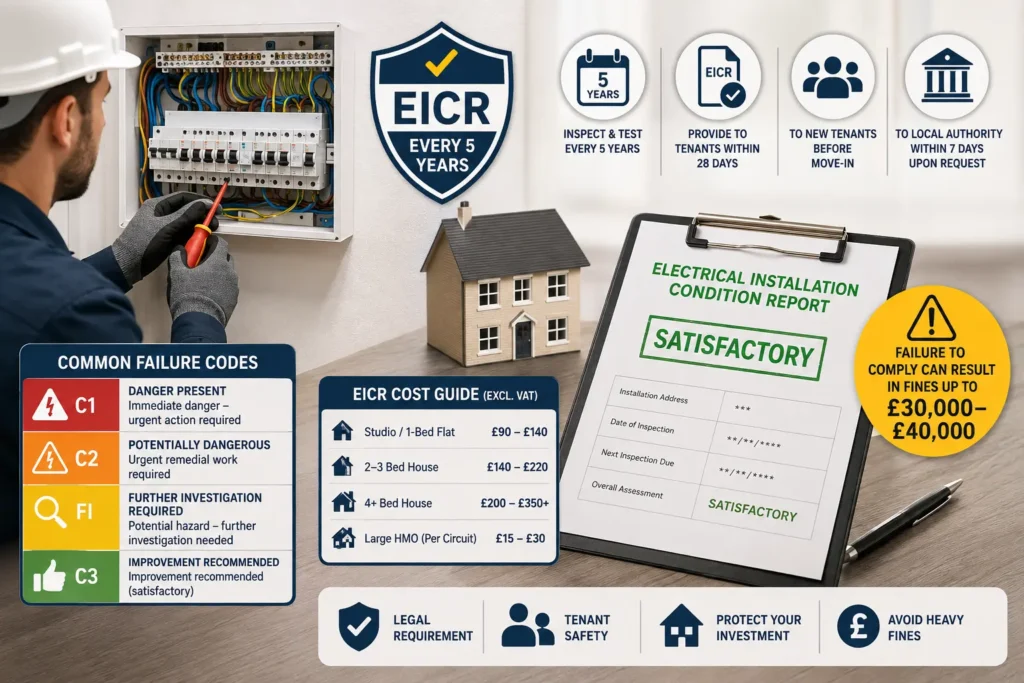
Quick Answer: Under The Electrical Safety Standards in the Private Rented Sector (England) Regulations 2020, landlords must have an Electrical Installation Condition Report (EICR) carried out at least every 5 years by a qualified electrician, supply a copy to tenants within 28 days, and fix any C1, C2, or FI safety faults within 28 days — or risk civil financial penalties of up to £30,000 from their local council.
Here is what changes when your EICR comes back unsatisfactory, what a fair 2026 quote actually looks like, and where most UK landlords get caught out on the 28-day compliance deadline.
What Is an EICR Certificate?
An Electrical Installation Condition Report (EICR) — often called an “electrical safety certificate” or “fixed wire test” by non-tradespeople — is an in-depth safety assessment of a property’s fixed electrical systems.
Conducted by a qualified electrician registered with accreditation bodies like NICEIC or NAPIT, an EICR evaluates the safety of the invisible infrastructure behind your walls in line with BS 7671 Wiring Regulations (18th Edition). Official guidance from Electrical Safety First underpins much of the diagnostic criteria used across the sector.
What an EICR Inspection Checks:
- The Consumer Unit (Fuse Box): Verification of modern Residual Current Devices (RCDs) or Residual Current Breakers with Overcurrent protection (RCBOs), correct circuit breaker sizing, and metal-clad enclosure standards.
- Fixed Wiring & Cables: Testing for insulation degradation, thermal damage, or obsolete cabling (such as lead-sheathed or vulcanised rubber wiring).
- Outlets & Light Switches: Inspecting socket outlets, switches, and spur units for cracking, overheating, loose connections, or improper earthing.
- Earthing and Bonding: Confirming main protective bonding to incoming gas and water services to prevent fatal electric shock risks.
Important Distinction: An EICR covers fixed wiring. Portable appliances supplied by the landlord (such as fridges, washing machines, or microwaves) fall under PAT (Portable Appliance Testing) or In-Service Inspection and Testing of Electrical Equipment (ISITEE) guidelines. For properties with gas heating, annual gas safety checks must also be conducted by an engineer listed on theGas Safe Register.
EICR Landlord Requirements & Legal Deadlines
Under current UK legislation, all private sector landlords letting residential premises in England must maintain valid electrical safety certification at all times.
The Post-Inspection Compliance Process:
- Engineer completes inspection: The inspector issues an EICR marked either Satisfactory or Unsatisfactory.
- If Satisfactory (Pass):
- Report is valid for 5 years (or less if the inspector explicitly specifies a shorter interval).
- Provide a copy to existing tenants within 28 days.
- Provide a copy to new tenants before they occupy the property.
- Provide a copy to the local housing authority within 7 days of a written request.
- If Unsatisfactory (Fail due to C1, C2, or FI codes):
- Complete remedial repairs or further investigation within 28 days (or sooner if specified on the report).
- Obtain written confirmation or an Electrical Installation Certificate (EIC) confirming the works are complete.
- Serve written confirmation of completed repairs to both existing tenants and the local council within 28 days of completion.
How Much Does an EICR Cost in the UK?
EICR pricing varies depending on property size, total circuit count, property age, and geographic location (London and the South East typically command higher labor rates).
Caution is advised regarding “discount” EICRs (£40–£50); a thorough inspection takes 2 to 4 hours. Unusually low prices frequently signal rushed visual checks or hidden call-out fees designed to force costly remedial work.
Note: Figures below reflect typical UK market rates as of Q3 2026 (excl. VAT), based on average job costs across our engineer network. Always request a written quote — final price depends on your consumer unit type and total circuit count.
| Property Type / Size | Average Cost Range (excl. VAT) | Estimated Inspection Duration |
| Studio / 1-Bed Flat | £90 – £140 | 1.5 – 2 hours |
| 2–3 Bed Terrace / Semi | £140 – £220 | 2.5 – 3.5 hours |
| 4+ Bed Detached / Period Home | £200 – £350+ | 4+ hours |
| Large HMO (per circuit) | £15 – £30/circuit | Varies by board size |
To secure an accurate quotation or schedule a certified inspection, explore our EICR testing and inspection services for accredited support.
Understanding EICR Classification Codes
When an engineer finishes testing, any defect or non-compliance observed is categorised using standard industry codes:
- Code C1 (Danger Present): Immediate risk of injury. Requires urgent action on the spot (e.g., exposed live wires). Result: Unsatisfactory.
- Code C2 (Potentially Dangerous): Urgent remedial work required to remove potential danger (e.g., absence of RCD protection on socket outlets, broken socket faceplate exposing internal parts). Result: Unsatisfactory.
- Code FI (Further Investigation Required): The engineer discovered a potential hazard that could not be fully verified without further investigation (e.g., an unmapped circuit or inaccessible junction box). Result: Unsatisfactory.
- Code C3 (Improvement Recommended): Does not breach current safety regulations, but upgrading would enhance safety (e.g., older style metal consumer unit that remains fully functional). Result: Satisfactory.
Engineer’s Checklist: Common Failure Points in Rental Properties
Qualified engineers routinely encounter the same compliance failures across UK rental properties. Addressing these items proactively can save significant time and money during an inspection:
- Outdated Consumer Units: Plastic consumer units lacking RCD/RCBO protection fail modern safety assessments. Scheduling a consumer unit upgrade to a modern, metal-clad board with dual RCDs or RCBOs is one of the most effective ways to ensure compliance.
- Missing Main Earthing/Bonding: Gas and water pipework entering Victorian or 1930s properties must be bonded back to the main earth terminal using 10mm² copper cable.
- Damaged Accessories: Cracked plastic light switches, loose wall sockets, or burn marks from overloaded space heaters trigger immediate C1 or C2 failure codes.
- DIY / Uncertified Work: A spur wired straight off the ring main without its own protection is one of the most common faults we find in properties bought from a previous owner who “did it themselves.” It’s an automatic C2 code. Properties requiring widespread repairs may benefit from a full property rewire.
Frequently Asked Questions (Landlord EICR Compliance)
Can a tenant refuse entry for an EICR inspection?
Yes — tenants have a right to quiet enjoyment under UK tenancy law. However, as a landlord you must show you have taken all reasonable steps to comply. Keep written records of every attempt to arrange access; these protect you from council fines if a tenant repeatedly refuses entry.
Does a new build property require an EICR?
If a property has been built or fully rewired within the last 5 years, an Electrical Installation Certificate (EIC) will have been issued. You can provide a copy of this EIC to new tenants to satisfy your legal duties without needing a separate EICR, provided the certificate is less than 5 years old.
What is the difference between an EICR and a PAT test?
An EICR assesses the fixed electrical installation (the wiring, fuse box, light fittings, and sockets built into the structure). A PAT test (Portable Appliance Testing) assesses movable electrical appliances plug-connected to the mains, such as washing machines, kettles, or fridges provided by the landlord.
Ensuring Total Property Compliance with Ultimate Engineers
Most of the C2 codes we issue on pre-1970s rentals come down to one thing: no RCD protection on the ring main. It’s a straightforward fix, usually done same-day — but it’s also the fault landlords most often don’t budget for.
At Ultimate Engineers UK, our team of registered, fully insured engineers carries out accredited EICR testing, consumer unit upgrades, complete rewires, and green energy retrofits.
If you are upgrading your rental property’s heating system alongside electrical works, our MCS-accredited engineers can advise on eligibility for active UK grants such as the Boiler Upgrade Scheme on GOV.UK, which offers £7,500 off heat pump installations (rising to £9,000 for off-gas-grid properties) and is administered under Ofgem’s scheme guidelines. Get in touch via our heat pump installation support team to check what your property qualifies for.
For full regulatory context, review the complete statutory text of The Electrical Safety Standards in the Private Rented Sector (England) Regulations 2020 or official statutory guidance on GOV.UK landlord electrical safety.
Disclaimer: All prices, costs, estimated timeframes, and service details mentioned on this page are provided for general guidance and may vary depending on location, project requirements, availability, market conditions, inflation, and other external factors. Final pricing, costs, and timelines will be confirmed at the time of quotation or service.

Talal Ehsan
Talal is a Site Manager and Project Handler at Ultimate Engineers, overseeing projects and ensuring professional delivery, quality, and compliance across engineering services.