
Commercial Gas Pressure Testing: When Is It Required and What Does It Involve?
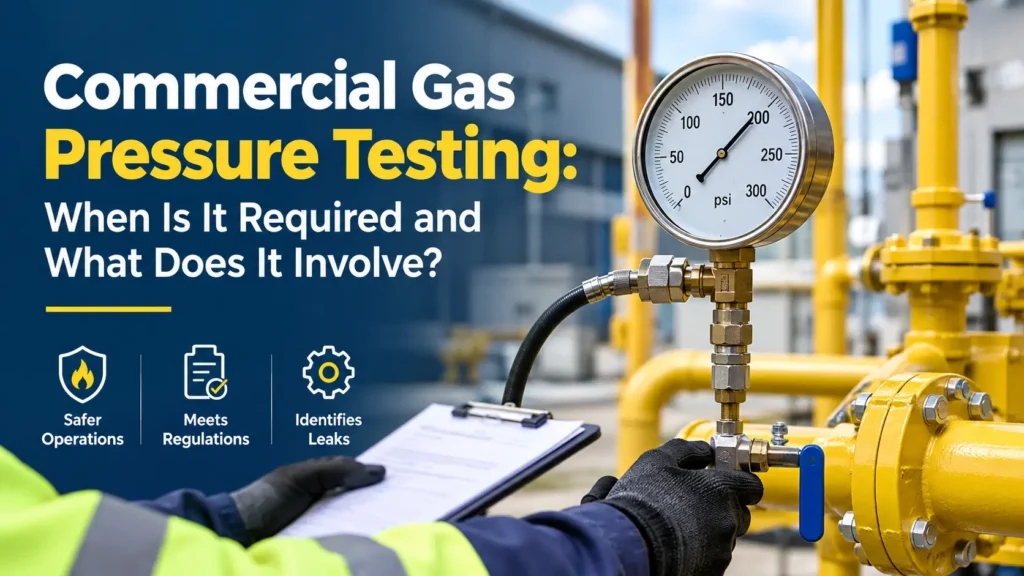
Commercial gas installations need to be safe, sound and properly maintained. One of the checks used to verify the integrity of relevant gas pipework is commercial gas pressure testing, often discussed alongside gas tightness testing.
For businesses, the subject is particularly important when installing new gas pipework, modifying an existing system, carrying out certain repairs, investigating suspected leaks or commissioning commercial heating and plant-room equipment. This guide explains when testing may be required, what the process involves and what businesses should expect from a competent gas engineer.
Quick answer: Commercial gas pressure testing is a controlled test used to assess the integrity and gas tightness of relevant pipework or an installation. It may be required after new installation work, alterations, extensions, repairs or other work that could affect gas tightness. The exact test procedure depends on the installation, operating conditions and applicable technical requirements.
What Is Commercial Gas Pressure Testing?
Commercial gas pressure testing is the process of testing a gas installation or relevant section of pipework to determine whether it remains adequately sound and gas-tight under specified test conditions.
The terms gas pressure testing, gas tightness testing and commercial pipework testing can overlap, but they should not automatically be treated as identical procedures. The appropriate test depends on the type of installation, the work being undertaken and the relevant engineering standard.
For larger premises, testing may form part of work involving commercial boilers, catering appliances, heating systems, industrial equipment, plant rooms or extensive internal gas pipework.
The Gas Safety (Installation and Use) Regulations 1998 (GSIUR) remain an important part of the UK’s gas safety framework. The official legislation is available through the UK Government’s legislation website.
When Is Commercial Gas Pressure Testing Required?
There is no universal rule saying that every commercial gas system must undergo the same pressure test at a fixed annual interval. The requirement depends on the work, installation and circumstances.
In practice, testing becomes particularly relevant when gas pipework has been installed, altered, repaired or otherwise disturbed.
1. New commercial gas installations
New gas pipework should be appropriately tested before the installation is commissioned and brought into use.
The purpose is straightforward: the engineer needs to establish that the completed installation is sufficiently sound and that connections and pipework do not present an unacceptable gas escape risk.
For a new commercial installation, testing should be considered as part of the overall installation, commissioning and handover process rather than as an optional extra.
2. Gas pipework alterations and extensions
Commercial buildings frequently change over time.
A business might add another boiler, replace catering equipment, extend a heating system or remodel a plant room. These projects can involve modifying existing gas pipework.
Where work could affect the gas tightness of the installation, appropriate testing is important after the work has been completed.
This is particularly relevant because an apparently minor alteration can introduce additional joints, fittings or connections into an existing system.
3. Repairs following a suspected gas leak
If a gas leak is suspected or an engineer identifies a defective section of pipework, testing may be used as part of the investigation and subsequent verification.
A recent HSE prosecution illustrates why gas-tightness checks should be taken seriously. HSE has reported cases where unsafe gas work resulted in leaks and required gas supplies to be isolated. HSE states that gas work must be carried out by appropriately registered and competent people.
The important point for a business is simple: a suspected gas leak should never be treated as a routine maintenance issue.
4. Recommissioning an installation
Commercial gas equipment may be taken out of service during refurbishment, equipment replacement or major maintenance.
Before an affected installation is returned to normal operation, the engineer may need to carry out appropriate checks and testing to establish that the installation is safe and suitable for recommissioning.
The exact requirements depend on what work was undertaken and what parts of the installation were affected.
5. Commercial plant-room projects
Plant-room upgrades can involve substantial changes to boilers, burners, valves, controls and gas pipework.
During these projects, pressure or tightness testing may form part of the wider commissioning process.
A professional project should consider gas testing from the planning stage rather than discovering at handover that additional testing, remedial work or documentation is required.
What Does a Commercial Gas Pressure Test Involve?
The exact procedure varies according to the installation. A competent engineer will determine the appropriate testing method rather than applying the same procedure to every commercial property.
Generally, the process involves several stages.
1. Inspecting and understanding the installation
Before testing begins, the engineer needs to understand what is being tested.
This may involve identifying:
- The relevant pipework
- Gas meter and isolation arrangements
- Valves and regulators
- Connected appliances
- Test points
- Operating pressure
- Pipework configuration
- The scope of recent work
This initial assessment is important because the test needs to reflect the actual installation.
2. Isolating the appropriate section
The relevant section of the gas installation is isolated in accordance with the planned testing procedure.
Depending on the circumstances, appliances and other components may need to be isolated or disconnected from the section being tested.
The objective is to make sure the test provides meaningful information about the part of the installation under investigation.
3. Applying the specified test condition
The engineer applies the appropriate test pressure or test condition using suitable equipment.
There is no single pressure figure that should be assumed for every commercial gas installation. The correct value and testing method depend on the installation and applicable technical requirements.
This is one reason why businesses should avoid relying on generic online instructions when dealing with commercial gas systems.
4. Monitoring for pressure loss or leakage
The engineer observes the installation during the relevant test period.
If the measured result falls outside the applicable acceptance criteria, further investigation may be required.
A failed test does not simply mean that the engineer should repeat it until it passes. The reason for the unacceptable result needs to be investigated and, where necessary, corrected.
5. Rectifying defects
Possible causes of an unacceptable result can include defective joints, damaged pipework, leaking fittings, faulty valves or other installation problems.
Any defects identified should be dealt with by a suitably competent person before the installation is returned to service.
6. Recording the outcome
For commercial work, appropriate documentation is important.
Depending on the job, records may include details of the installation, work undertaken, testing performed, results obtained, defects identified and remedial work completed.
The exact documentation provided should reflect the nature of the project and the relevant requirements.
Is Gas Pressure Testing the Same as a Commercial Gas Safety Check?
No. These activities can be related, but they are not automatically the same thing.
A commercial gas safety check may involve examination of appliances, flues, combustion performance, operating conditions and other safety considerations.
A gas tightness test, meanwhile, focuses on the integrity of the relevant gas installation.
A business may therefore require several different checks as part of a broader gas safety, servicing, commissioning or maintenance programme.
The correct combination depends on the installation and the work being carried out.
Why Is Gas Tightness Testing Important for Businesses?
Gas safety is ultimately about controlling risk.
A leak can allow flammable gas to accumulate in an enclosed or poorly ventilated area. Under the right conditions, an ignition source could result in fire or explosion. Gas appliances can also create carbon monoxide risks where combustion or flue arrangements are defective.
HSE’s current pressure-testing guidance describes pressure testing as a high-risk activity because stored energy can be released unexpectedly. Its guidance emphasises risk assessment, written safe systems of work, segregation of the test area and properly maintained test connections.
This is particularly relevant to commercial environments where testing may take place around employees, contractors, customers, plant and other operational equipment.
HSE’s Cross-Government Group on Gas Safety and Carbon Monoxide Awareness recorded 110 reportable gas-related incidents and five fatalities in 2023/24. These figures cover reportable gas incidents across the relevant UK reporting framework and are not limited to commercial premises. HSE notes that the figures are reported data and that the circumstances of incidents may not yet have been fully confirmed when initially recorded.
For businesses, the figures reinforce why competent gas installation work, appropriate testing and effective safety controls should be treated as essential rather than optional.
Who Should Carry Out Commercial Gas Pressure Testing?
Commercial gas work should be undertaken by a suitably competent and appropriately Gas Safe registered engineer, with qualifications and competence relevant to the type of work being performed.
This distinction matters. Being registered does not mean that an individual is automatically qualified to undertake every type of gas work.
For complex commercial installations, businesses should establish that the engineer has the appropriate competence for the appliance type, gas installation and work involved.
HSE has repeatedly highlighted the dangers of gas work carried out by people without the necessary competence or registration.
Do Commercial Gas Systems Need Pressure Testing Every Year?
Not necessarily.
Commercial gas pressure testing should not be confused with routine annual servicing or safety inspection requirements.
Whether a particular pressure or tightness test is required depends on factors such as:
- Whether new pipework has been installed
- Whether existing pipework has been altered
- Whether repairs have been undertaken
- Whether a leak or defect has been suspected
- Whether an installation is being recommissioned
- The type and design of the gas installation
- The applicable technical requirements
A business should therefore ask its competent gas engineer what testing is appropriate for its specific installation rather than assuming that one fixed annual pressure test applies to every system.
What Happens If a Pressure Test Fails?
A failed test should trigger investigation.
The engineer may need to identify where gas is escaping or why the installation is not achieving the required result. This could involve checking joints, fittings, valves, connections or sections of pipework.
The defective component or section should then be repaired or replaced as appropriate, followed by the relevant verification or testing.
Where there is an immediate safety concern, the gas supply or affected equipment may need to be isolated until the problem has been made safe.
HSE’s gas incident investigation guidance specifically recognises tightness testing of internal gas installations as part of investigating gas leaks and incidents.
How Can Businesses Prepare for Commercial Gas Pressure Testing?
A little preparation can make the process considerably easier.
Before the engineer arrives, a facilities or building manager should, where possible, provide:
- Details of recent gas installation work.
- Access to the gas meter, plant room and relevant pipework.
- Information about connected appliances.
- Existing gas installation or commissioning documentation.
- Details of any previous gas leaks or faults.
- Information about equipment that cannot be taken out of service.
- A suitable working area for the engineer.
For larger sites, coordination with facilities, maintenance and health-and-safety teams can also help minimise operational disruption.
FAQs About Commercial Gas Pressure Testing
What is commercial gas pressure testing?
Commercial gas pressure testing is a controlled engineering test used to assess the integrity and gas tightness of relevant commercial gas pipework or an installation under specified conditions.
When is a gas tightness test required?
It may be required after new installation work, alterations, extensions, repairs or other work that could affect the gas tightness of an installation. The exact requirement depends on the circumstances and applicable technical standards.
Is commercial gas pressure testing the same as servicing?
No. A gas service involves inspection and maintenance of relevant gas appliances and systems, while pressure or tightness testing focuses on the integrity of the relevant gas installation.
Can any gas engineer carry out commercial pressure testing?
The work should be carried out by a suitably competent Gas Safe registered engineer whose qualifications and scope of competence match the installation and work involved.
Is there a fixed annual requirement for commercial gas pressure testing?
Not generally. Pressure testing should not automatically be treated as an annual requirement for every commercial gas installation. The need for testing depends on the installation, work undertaken and relevant safety requirements.
Commercial Gas Pressure Testing: The Bottom Line
Commercial gas pressure testing is an important part of verifying the integrity of gas installations when installation, alteration, repair, commissioning or other work could affect gas tightness.
It is not simply a routine paperwork exercise. A properly planned test can help identify leakage or installation defects before they create a more serious safety problem.
For businesses, the safest approach is to use a suitably competent Gas Safe registered professional who can assess the installation, determine the appropriate testing procedure and provide the relevant documentation.
If your commercial premises requires gas installation, servicing, maintenance or testing support, you can explore commercial gas services from Ultimate Engineers.
Official UK Guidance and Further Reading
- Health and Safety Executive (HSE) — Gas safety: official UK workplace gas safety guidance.
- Gas Safety (Installation and Use) Regulations 1998: official legislation on gas installation and use.
- HSE GS4 — Safety requirements for pressure testing: official guidance covering risks, safe systems of work and pressure-testing controls.
- HSE gas incident guidance: information on gas incidents, reporting and investigation.
Content note: This article provides general UK gas-safety information and should not be used as a substitute for a site-specific assessment or the applicable technical standards and manufacturer’s instructions.
Disclaimer: All prices, costs, estimated timeframes, and service details mentioned on this page are provided for general guidance and may vary depending on location, project requirements, availability, market conditions, inflation, and other external factors. Final pricing, costs, and timelines will be confirmed at the time of quotation or service.

Talal Ehsan
Talal is a Site Manager and Project Handler at Ultimate Engineers, overseeing projects and ensuring professional delivery, quality, and compliance across engineering services.