
Commercial Gas Servicing: A Complete Guide for Businesses
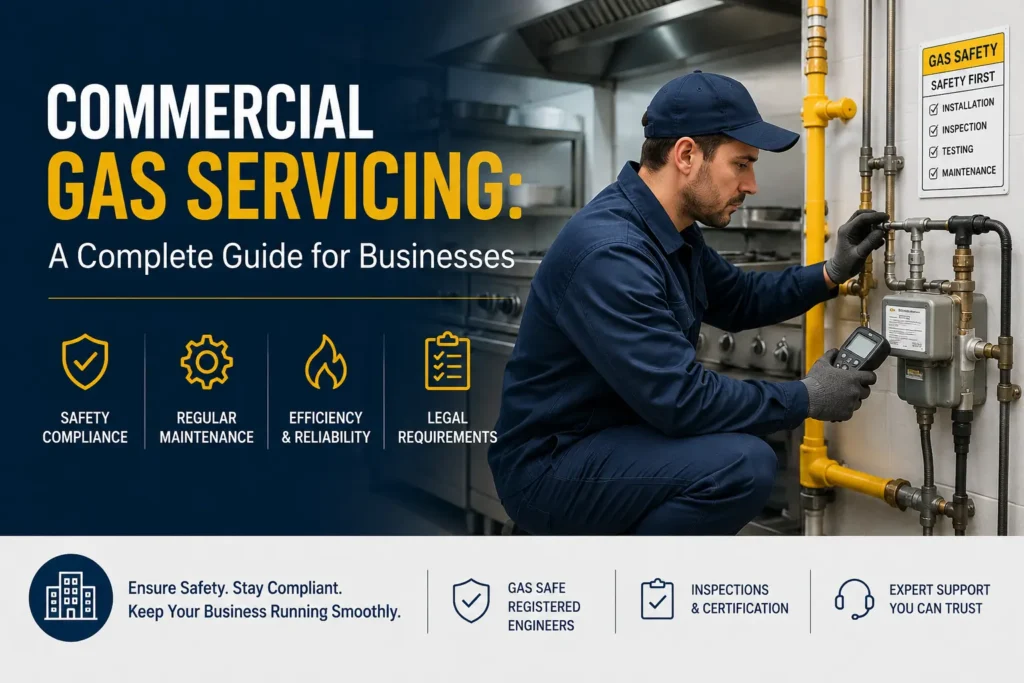
A commercial boiler failing on a cold Monday morning is more than a heating problem.
It can mean uncomfortable staff, disrupted operations, unhappy customers, cancelled services and an emergency engineering call that could have been avoided with better maintenance planning.
The same applies to gas-fired catering equipment, water heaters, warm-air heaters and plant-room appliances. When these systems are poorly maintained, the consequences can go beyond reduced performance. Gas leaks, fire, explosion and carbon monoxide exposure are among the risks identified by the Health and Safety Executive (HSE).
That is why commercial gas servicing should be viewed as part of responsible facilities management—not simply something to arrange when an appliance stops working.
This guide explains what commercial gas servicing involves, how frequently commercial gas equipment should be serviced, who is legally qualified to work on it, what businesses should expect from a professional service, and how to build gas maintenance into a practical planned preventative maintenance programme.
Quick Answer: What Is Commercial Gas Servicing?
Commercial gas servicing is the inspection, testing, maintenance and, where appropriate, cleaning or adjustment of gas-fired equipment and associated components in commercial premises.
Depending on the installation, this may involve commercial boilers, catering appliances, gas-fired water heaters, warm-air heaters, burners, installation pipework, flues, ventilation and safety controls.
The exact scope and frequency should be based on the equipment manufacturer’s instructions, the installation, how the equipment is used, relevant legal duties and the advice of a competent engineer.
HSE states that employers should regularly maintain gas pipework, appliances and flues and use a Gas Safe registered engineer or other competent person as applicable.
Why Commercial Gas Servicing Matters to Businesses
A domestic boiler might operate for a few hours a day.
A commercial gas installation can be working for much longer—and in some environments, almost continuously.
Think about a restaurant kitchen during a busy service, a school boiler plant during winter, or a commercial building where heating and hot water are essential to daily operations.
Small faults can therefore become expensive problems when they are ignored.
Regular maintenance can help businesses:
-
- identify developing faults earlier
-
- maintain safe operation
-
- reduce unexpected breakdowns
-
- protect critical heating and hot-water services
-
- maintain equipment performance
-
- plan repairs instead of reacting to emergencies
-
- keep useful maintenance records
-
- manage gas-related risks more systematically
-
- support wider planned preventative maintenance (PPM)
Importantly, servicing is not a guarantee that an appliance will never fail. Components wear out, controls fail and unexpected faults happen.
The value of servicing is that it gives a business a better opportunity to identify deterioration before a relatively manageable issue becomes a major operational problem.
What Does Commercial Gas Servicing Include?
There is no universal checklist that applies identically to every commercial gas installation.
A competent engineer should consider the appliance type, manufacturer’s instructions, installation arrangement, operating environment and relevant safety requirements.
A professional service may include the following areas.
1. Initial Visual Inspection
The engineer will normally start by assessing the general condition of the appliance and accessible installation.
They may look for:
-
- corrosion
-
- physical damage
-
- deterioration
-
- signs of overheating
-
- damaged components
-
- unsuitable modifications
-
- installation concerns
-
- problems around ventilation
-
- visible issues with flues or chimneys
This first inspection can reveal obvious problems before detailed testing begins.
2. Appliance Operation and Safety
The engineer assesses whether the appliance is operating safely and as intended.
Depending on the equipment, this may involve examining components such as:
-
- burners
-
- ignition systems
-
- flame-failure devices
-
- thermostats
-
- fans
-
- controls
-
- heat exchangers
-
- seals
-
- safety controls
-
- other manufacturer-specified components
The precise checks depend on the appliance.
A commercial boiler, for example, will not require exactly the same servicing procedure as a commercial cooking appliance.
3. Combustion and Performance Checks
Combustion performance is an important part of maintaining gas-fired equipment.
Poor combustion can affect performance and, in some circumstances, contribute to carbon monoxide production.
HSE warns that improperly installed or maintained gas appliances can present risks including carbon monoxide poisoning, fire, gas leaks and explosion.
Appropriate testing should therefore be carried out using the procedures and equipment relevant to the appliance.
4. Gas Pressure and Related Checks
Where applicable, the engineer may assess gas pressures and other operating conditions against the requirements of the appliance and installation.
Abnormal readings can point towards issues with:
-
- the appliance
-
- gas supply
-
- controls
-
- burners
-
- installation conditions
Any required testing should be carried out by a suitably competent engineer.
5. Flue and Chimney Assessment
The safe removal of combustion products is critical.
Depending on the installation, the engineer may inspect the accessible parts of the flue system and consider whether there are signs of deterioration, obstruction or other problems.
A flue should never be treated as an afterthought. A gas appliance can be functioning apparently normally while problems with combustion-product removal create a serious safety issue.
HSE’s gas-safety guidance specifically includes appliances, installation pipework, ventilation and flues within maintenance considerations.
6. Ventilation Checks
Adequate ventilation is particularly important where combustion appliances are installed.
Air inlets should not be blocked, and ventilation arrangements need to remain suitable for the equipment.
This becomes especially important in commercial kitchens.
HSE’s catering guidance highlights the relationship between gas appliances and mechanical ventilation, including the importance of suitable interlocking arrangements where applicable.
7. Installation Pipework
Commercial gas servicing may also involve examination of accessible installation pipework.
Pipework should be maintained in a safe condition, with defects addressed appropriately.
HSE recommends regular inspections and necessary repairs as part of effective gas maintenance.
8. Cleaning and Preventive Maintenance
Depending on the appliance and manufacturer’s requirements, servicing may include cleaning relevant components and carrying out appropriate adjustments.
This can be particularly important for equipment operating in demanding environments.
Commercial kitchens are a good example. Grease, heat, cooking by-products and heavy usage can place additional demands on both appliances and ventilation systems.
9. Defect Reporting and Recommendations
One of the most useful parts of a professional commercial gas service is not simply finding a problem—it is explaining what the problem means.
A good service report should make it clear:
-
- what equipment was inspected
-
- what was tested
-
- what defects were identified
-
- whether immediate action is required
-
- what remedial work is recommended
-
- whether further investigation is necessary
That gives the facilities manager something actionable rather than a vague statement saying “service completed”.
How Often Should Commercial Gas Appliances Be Serviced?
There is no single servicing interval that automatically applies to every commercial gas appliance.
The appropriate interval depends on factors such as:
-
- manufacturer’s instructions
-
- appliance type
-
- operating hours
-
- intensity of use
-
- installation condition
-
- working environment
-
- previous maintenance history
-
- risk assessment
-
- applicable legal requirements
-
- recommendations from a competent engineer
HSE guidance says gas appliances and flues should be serviced in accordance with the manufacturer’s instructions. Where those instructions are unavailable, HSE recommends annual servicing in the landlord context unless a Gas Safe registered engineer advises otherwise.
For commercial catering equipment, HSE states that inspection periods may vary according to the equipment and its use and should follow manufacturer’s recommendations; it also notes that annual inspections can be a reasonable minimum as a general rule.
The practical answer for a business
Don’t ask only:
“Is an annual service enough?”
Ask:
“What maintenance interval is appropriate for this specific appliance and how it is being used?”
That is a much more useful question.
A lightly used appliance in a controlled environment may have different maintenance requirements from heavily used equipment operating every day in a busy commercial kitchen.
Is Annual Commercial Gas Servicing a Legal Requirement?
This is one area where businesses need to be careful with generic online advice.
There is not a blanket rule saying every commercial property must obtain an annual commercial gas safety certificate.
The legal requirements depend on the premises, installation and specific duties that apply.
The Gas Safety (Installation and Use) Regulations 1998 (GSIUR) cover the safe installation, maintenance and use of gas systems, including gas fittings, appliances and flues in domestic and certain commercial premises.
There are also specific landlord duties under Regulation 36 for relevant rented properties. These should not automatically be confused with the maintenance requirements applying to every commercial business.
This distinction matters because:
Commercial gas servicing ≠ automatically the same thing as a statutory annual gas safety check.
Likewise:
A gas safety check ≠ necessarily a complete appliance service.
Businesses should establish which inspections, maintenance activities and records apply to their particular installation.
Commercial Gas Service vs Gas Safety Check: What’s the Difference?
These terms are often mixed together, but they serve different purposes.
Commercial Gas Service
A service is generally concerned with the condition, operation and maintenance of equipment.
It can involve:
-
- inspection
-
- cleaning
-
- testing
-
- adjustment
-
- performance checks
-
- component assessment
-
- preventive maintenance
Gas Safety Check
A gas safety check has a defined safety purpose under the applicable regulatory requirements.
HSE explains that effective maintenance involves examining the physical condition and safe functioning of appliances, installation pipework, ventilation and flues, carrying out performance tests and taking necessary remedial action.
For businesses, the safest approach is to ask the contractor:
“Exactly what checks are included in your service, and what documentation will I receive?”
That one question can prevent a lot of confusion.
Who Can Carry Out Commercial Gas Servicing?
Gas work is specialist work.
For workplaces such as shops, restaurants, schools and hospitals, HSE states that work on gas fittings must be undertaken by a Gas Safe registered engineer who is qualified to do that work.
A business should not assume that someone is competent simply because they describe themselves as:
-
- a plumber
-
- heating engineer
-
- maintenance contractor
-
- boiler engineer
The relevant gas competence matters.
Gas Safe registration identifies the areas of gas work an engineer is qualified to undertake, and businesses should check that the engineer’s qualifications match the work required. HSE specifically advises employers to verify both registration and competence.
Before allowing gas work on your premises, check:
-
- Is the business Gas Safe registered where registration is required?
-
- Is the individual engineer appropriately qualified?
-
- Does their registration cover the type of gas work involved?
-
- Do they have relevant commercial competence?
-
- Can they work on your specific appliance type?
-
- Will they provide a clear service report?
-
- Can they deal with remedial work if defects are found?
Gas Safe registration should be verified rather than accepted purely on a contractor’s word.
What Happens If a Commercial Gas Appliance Is Unsafe?
If a competent engineer identifies a serious safety issue, the answer should not be:
“We’ll keep using it until the replacement arrives.”
An appliance known or suspected to be unsafe should not continue operating simply because it is inconvenient to shut it down.
The engineer should explain the defect, its significance and the appropriate next step.
Depending on the circumstances, this could mean:
-
- repair
-
- replacement of a component
-
- further testing
-
- isolation
-
- taking the appliance out of service
-
- wider remedial work
HSE advises that employers should not use gas appliances they know or suspect to be unsafe.
For facilities managers, this is where having a planned maintenance relationship with a competent contractor becomes valuable. If a problem is found during a service, there is already a process for assessing and resolving it.
A Real-World Lesson from HSE: Why Maintenance Matters
There is a useful lesson in HSE’s own enforcement examples.
HSE describes an incident at a primary school where pupils and staff were evacuated after being overcome by dangerous levels of carbon monoxide. The investigation found that carbon monoxide was being produced by an inadequately maintained boiler and entering the classroom above.
The employer already had a maintenance system, but poor practices had developed within that system and were not identified until after the incident. The employer was fined £10,000 and ordered to pay £6,830 in costs.
The lesson for commercial property managers is important:
Having a maintenance schedule on paper is not enough. The maintenance programme needs to be properly implemented, monitored and followed through.
That means checking whether defects are actually resolved—not simply recording that an engineer visited.
Commercial Gas Servicing for Restaurants and Commercial Kitchens
Commercial kitchens deserve special attention.
Gas appliances can include:
-
- ranges
-
- ovens
-
- fryers
-
- grills
-
- boiling pans
-
- burners
-
- specialist cooking equipment
At the same time, kitchens often depend heavily on mechanical extraction and ventilation.
HSE highlights the importance of effective ventilation and appropriate interlocking between mechanical ventilation systems and gas supplies where applicable. If ventilation fails, the gas supply to appliances may need to be shut off through the appropriate safety arrangement.
Kitchen operators should therefore think beyond the appliance itself.
A gas appliance, ventilation system, extraction arrangement and associated safety controls can form part of one operational safety picture.
HSE also identifies inadequate maintenance and heavy use without appropriate ventilation as factors that can increase risk in catering environments.
Commercial Gas Servicing for Offices, Schools and Other Facilities
Gas servicing is relevant far beyond restaurants.
Offices
Commercial boilers and water-heating systems may support staff welfare and building operation. A heating failure can quickly become a business continuity issue.
Schools
Heating and hot water are essential services. Maintenance needs to be planned around term dates, access requirements and the condition of critical plant.
Healthcare Buildings
Reliability can be especially important where heating and hot water support essential building functions.
Warehouses and Industrial Facilities
Large heating appliances and plant-room equipment can require specialist commercial maintenance and coordinated shutdown planning.
Hotels and Hospitality
Heating, hot water and catering systems can all affect the guest experience and day-to-day operations.
Retail and Public Buildings
Heating and hot water failures can affect staff, customers and the operation of the building itself.
The common factor is simple:
When gas equipment supports an important business function, maintenance becomes part of operational risk management.
Commercial Gas Servicing vs Reactive Gas Repairs
Reactive maintenance begins when the problem has already happened.
For example:
Boiler fails → business calls engineer → engineer diagnoses fault → repair is arranged.
Planned maintenance takes a different approach:
Equipment is inspected → condition is assessed → developing problems are identified → maintenance or repairs are planned.
Neither strategy eliminates breakdowns completely.
But relying exclusively on reactive repairs can leave a business vulnerable to:
-
- unexpected downtime
-
- emergency call-out costs
-
- unavailable heating
-
- loss of hot water
-
- disruption to operations
-
- urgent parts procurement
-
- difficult scheduling
For critical commercial equipment, servicing should ideally form part of a broader PPM strategy.
How Commercial Gas Servicing Fits Into PPM
Planned Preventative Maintenance is about managing equipment before it becomes a failure.
A practical commercial gas PPM programme can include:
Asset Register
Record each gas appliance, location, manufacturer and model.
Maintenance Requirements
Document manufacturer’s recommended maintenance requirements.
Inspection Schedule
Set appropriate service and inspection dates.
Defect Tracking
Record defects and track them until they are resolved.
Documentation
Keep service reports, test results and relevant safety records organised.
Responsibility
Clearly identify who is responsible for arranging inspections and remedial work.
Review
Review recurring faults and ageing equipment rather than repeatedly repairing the same problem without considering replacement.
This approach can help facilities managers move from:
“What has broken?”
to:
“What equipment needs attention before it fails?”
That is a much stronger maintenance mindset.
What Should Be Included in a Commercial Gas Service Report?
A useful report should give the business enough information to understand what happened during the visit.
Depending on the work undertaken, it may include:
-
- site information
-
- appliance identification
-
- appliance location
-
- engineer details
-
- inspection date
-
- checks performed
-
- test results where applicable
-
- defects identified
-
- safety observations
-
- remedial work
-
- parts replaced
-
- recommendations
-
- follow-up actions
Where a statutory gas safety record applies, the record has specific information requirements. HSE provides guidance on the information that must be recorded for applicable gas safety checks.
A service report should not be confused with a statutory gas safety record unless the contractor has actually carried out the relevant check and provided the required record.
How to Choose a Commercial Gas Servicing Company
Price matters.
But for commercial gas work, competence should come before price.
A cheap service from the wrong contractor can become expensive very quickly if a defect is missed or the engineer is not qualified for the equipment.
1. Check Gas Safe Registration
Verify the contractor through Gas Safe Register where the work falls within its scope.
2. Check the Engineer’s Competence
Registration alone is not the end of the conversation. Check that the engineer has the relevant competency for the equipment.
3. Look for Commercial Experience
Commercial gas installations can be substantially different from domestic systems.
Ask whether the contractor regularly works on the type of equipment installed at your premises.
4. Ask What the Service Includes
Avoid vague descriptions.
Ask for the actual scope of work.
5. Request Written Reporting
You should know what was inspected, what was found and what needs attention.
6. Ask About Remedial Work
If the engineer finds a fault, can the contractor repair it or arrange the next stage quickly?
7. Consider Emergency Support
For critical heating, hot-water or catering equipment, emergency support can be just as important as routine servicing.
8. Consider Planned Maintenance
For larger sites, a contractor that can support ongoing maintenance may provide greater value than a company that only attends individual breakdowns.
How Much Does Commercial Gas Servicing Cost?
There is no meaningful universal price for commercial gas servicing.
A small office with one boiler is a completely different job from a large commercial property with multiple boilers, burners, hot-water systems and plant-room equipment.
Pricing can depend on:
-
- number of appliances
-
- appliance type
-
- appliance size
-
- location
-
- accessibility
-
- system complexity
-
- operating environment
-
- number of engineers required
-
- testing requirements
-
- condition of the equipment
-
- parts required
-
- remedial work
-
- number of site visits
For that reason, businesses should be cautious about choosing a contractor solely on the basis of an unusually low advertised price.
The better question is:
“What exactly is included in the price?”
Two companies can quote very different prices because they are offering different scopes of work.
Signs Your Commercial Gas Equipment May Need Attention
Businesses should not wait for a complete failure before investigating warning signs.
Potential indicators can include:
-
- unusual noises
-
- repeated ignition failures
-
- unexplained shutdowns
-
- recurring fault codes
-
- unusual smells
-
- visible corrosion
-
- soot or staining
-
- poor heating performance
-
- inconsistent hot water
-
- repeated breakdowns
-
- damaged ventilation arrangements
-
- damaged or obstructed flues
-
- unusual changes in equipment performance
If a business suspects a gas leak or unsafe appliance, it should follow the appropriate emergency procedure and use a competent professional to investigate the installation.
HSE advises that suspected unsafe gas appliances should not be used.
Commercial Gas Servicing Checklist for Facilities Managers
Use this checklist when reviewing your gas maintenance arrangements:
-
- Have all commercial gas appliances been identified?
-
- Do you know where each appliance is located?
-
- Are manufacturer servicing requirements available?
-
- Is there an appropriate maintenance schedule?
-
- Is the contractor suitably registered and competent?
-
- Has the engineer’s relevant gas competence been checked?
-
- Are appliances maintained regularly?
-
- Are installation pipework and relevant flues appropriately maintained?
-
- Are ventilation arrangements checked where relevant?
-
- Are defects recorded?
-
- Are remedial actions tracked to completion?
-
- Are service reports stored centrally?
-
- Are applicable statutory records maintained?
-
- Is emergency support available?
-
- Is gas maintenance included within the wider PPM programme?
If several answers are “no”, your current gas maintenance process may deserve a review.
Frequently Asked Questions About Commercial Gas Servicing
What is commercial gas servicing?
Commercial gas servicing is the inspection, testing and maintenance of gas-fired equipment used in non-domestic premises. Depending on the installation, it can cover appliances, controls, pipework, flues, ventilation and other relevant components.
How often should commercial gas appliances be serviced?
There is no single interval for every commercial appliance. Follow the manufacturer’s instructions and consider equipment type, usage, installation condition and risk. A competent commercial gas engineer can help determine an appropriate maintenance programme.
Is annual commercial gas servicing legally required?
Not universally. Legal duties depend on the premises, installation and circumstances. GSIUR contains specific requirements relating to gas systems, appliances, fittings and flues, while particular annual gas safety check duties apply to relevant landlord situations. Businesses should not treat “annual certificate” as a universal rule for every commercial property.
Is a commercial gas service the same as a gas safety check?
No. A service and a gas safety check can have overlapping elements, but they are not automatically the same activity or document. Ask your contractor exactly what checks are being carried out and what documentation will be issued.
Does a commercial gas service include the flue?
The flue should be considered where it forms part of the relevant gas installation, but the exact scope depends on the equipment and service being performed. Flues and combustion-product arrangements are important safety considerations and should be assessed by an appropriately competent person.
Does commercial gas servicing include ventilation?
Where ventilation is relevant to the gas installation, it should be considered as part of the safety assessment. This is particularly important in commercial kitchens, where appliance operation and mechanical extraction can be closely connected.
Can any plumber service a commercial gas boiler?
No. Gas work must be carried out by an appropriately competent person. For workplaces covered by GSIUR, HSE states that gas-fitting work must be carried out by a Gas Safe registered engineer qualified for the work.
What happens if an engineer finds an unsafe gas appliance?
The appliance should not simply remain in use because shutting it down is inconvenient. The engineer should explain the defect and appropriate action, which may include repair, further investigation, isolation or removal from service.
Can servicing prevent commercial boiler breakdowns?
Servicing cannot eliminate the possibility of failure, but it can help identify deterioration and developing faults before they result in more serious problems. It is therefore an important part of preventative maintenance.
Do commercial kitchens need regular gas inspections?
Commercial kitchens have particular gas-safety considerations because of intensive appliance use and ventilation requirements. HSE recommends appropriate inspection and maintenance of gas appliances, flues, pipework and safety devices, with inspection intervals based on equipment, use and manufacturer recommendations.
Should gas servicing be part of a PPM programme?
For many commercial properties, yes. Integrating gas servicing into a wider PPM programme makes it easier to schedule maintenance, track defects and plan remedial work before critical equipment fails.
When Should a Business Book Commercial Gas Servicing?
Don’t wait for a boiler, water heater or catering appliance to stop working before thinking about maintenance.
A sensible time to review your commercial gas servicing arrangements is when:
-
- equipment is approaching its recommended service date
-
- the system has experienced repeated faults
-
- a building has changed its use
-
- new gas appliances have been installed
-
- equipment is operating more heavily than before
-
- maintenance records are incomplete
-
- you have recently taken over a commercial property
-
- recurring repairs are becoming expensive
-
- your current contractor cannot demonstrate the relevant competence
-
- you are reviewing your wider PPM strategy
The earlier a maintenance problem is identified, the more options a business usually has.
Professional Commercial Gas Servicing for UK Businesses
Gas systems are too important to manage purely on a breakdown-by-breakdown basis.
Whether your property relies on commercial boilers, gas-fired hot-water equipment, catering appliances or plant-room systems, a properly structured maintenance programme can help you manage safety, reliability and operational risk.
Ultimate Engineers provides commercial gas services for businesses looking for professional support with gas equipment, servicing, maintenance and related requirements.
If your commercial gas system needs servicing, maintenance or professional assessment, you can explore the commercial gas servicing service offered by Ultimate Engineers.
For businesses with larger or more complex installations, it can also be useful to discuss a planned maintenance approach rather than treating every gas issue as a separate emergency.
Final Takeaway
Commercial gas servicing is not simply about keeping a boiler running.
It is about taking a proactive approach to the safety, condition and reliability of gas equipment that your business depends on.
The strongest approach is to:
-
- Know exactly what gas equipment you have.
-
- Follow the relevant manufacturer’s maintenance requirements.
-
- Use appropriately qualified and competent engineers.
-
- Check Gas Safe registration where applicable.
-
- Maintain appliances, relevant pipework, flues and ventilation appropriately.
-
- Record defects and make sure remedial work is completed.
-
- Keep appropriate maintenance and statutory records.
-
- Include gas equipment within your wider PPM strategy.
-
- Review recurring faults instead of repeatedly treating symptoms.
-
- Use current HSE and official guidance when reviewing your gas-safety arrangements.
A good maintenance programme does not promise that nothing will ever go wrong.
It gives your business a much better chance of finding problems early, dealing with them properly and avoiding preventable disruption.
Sources
HSE – Gas Safety for Employers: for employers’ gas-safety responsibilities, competent engineers, appliances, pipework, flues, and ventilation.
HSE: Gas safety for employers: HSE – Maintenance of Gas Appliances and Flues — for maintenance frequency and guidance on checking and servicing appliances, flues, and pipework.
HSE: Maintenance – gas appliances and flues: HSE – Catering and Hospitality Gas Safety — for commercial kitchens and ventilation/interlocking context.
HSE: Gas safety in catering and hospitality: HSE – Catering Gas Equipment FAQs — for maintenance frequency guidance on commercial catering equipment.
HSE: Catering equipment maintenance FAQs: Legislation.gov.uk – Gas Safety (Installation and Use) Regulations 1998 — for the underlying legislation.
Gas Safety (Installation and Use) Regulations 1998: HSE – Check an Engineer (Gas Safe Register) — for verifying Gas Safe registration and engineer competence.
HSE: Check an engineer – are they Gas Safe registered?
Disclaimer: All prices, costs, estimated timeframes, and service details mentioned on this page are provided for general guidance and may vary depending on location, project requirements, availability, market conditions, inflation, and other external factors. Final pricing, costs, and timelines will be confirmed at the time of quotation or service.

Talal Ehsan
Talal is a Site Manager and Project Handler at Ultimate Engineers, overseeing projects and ensuring professional delivery, quality, and compliance across engineering services.